

 Editor

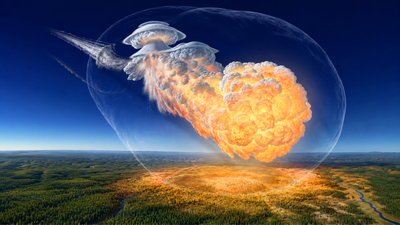
An explosion powerful enough to destroy millions of trees should have left behind a giant crater. Instead, when scientists finally reached the remote Siberian wilderness where the blast had occurred, they found only a forest laid out like matchsticks. There was no impact hole, no massive meteorite and no obvious explanation for the devastation. More than a century later, the Tunguska event remains the largest impact event in recorded human history and one of science’s greatest unsolved natural mysteries. Estimated to have released 10 to 15 megatons of energy, hundreds of times more powerful than the Hiroshima atomic bomb, the explosion reshaped not only the Siberian landscape but also humanity’s understanding of the dangers posed by objects from space.
Scientists searched for the crater after 80 million trees were wiped out, but found a bigger mystery
When Soviet mineralogist Leonid Kulik arrived in the Siberian taiga in 1927, nearly two decades had passed since local people reported a colossal explosion. Kulik had convinced the Soviet Academy of Sciences to fund an expedition because he believed a giant meteorite had struck the region. Recovering such a meteorite, particularly if it contained iron, could have been scientifically and economically valuable for the young Soviet Union.What he found instead confounded expectations.Stretching before him was a vast expanse of flattened forest covering roughly 2,150 square kilometres. Around 80 million trees had been knocked down, yet there was no impact crater anywhere in sight. Even more puzzling, the destruction followed an unusual pattern. Trees closer to the centre of the blast had been stripped of their branches but remained standing upright like burnt telegraph poles, while those farther away had fallen outward in every direction. Kulik later remarked that it looked as though “a giant had mowed the forest with a scythe.”His photographs of the devastated landscape became some of the most iconic images in planetary science. They also provided the first major clue that the explosion had occurred above the ground rather than on impact.Around 80 million trees were destroyed, yet investigators found only a forest laid out like matchsticks radiating from a single point, with no impact crater at its centre.

The day the Siberian sky caught fire
Long before scientists reached the site, residents had already witnessed one of the most extraordinary natural events in recorded history.On the morning of 30 June 1908, shortly after 7 am local time, people across central Siberia reported seeing an intensely bright object streak across the sky. Witnesses described a bluish-white fireball brighter than the Sun, followed by a series of deafening explosions that shook the ground and sent shockwaves racing through the atmosphere.One of the best-known eyewitnesses, Semyon Semenov, who was about 65 kilometres from the epicentre, later recalled that “the sky split in two” before an intense wave of heat struck him, throwing him from his porch. Members of the indigenous Evenki community spoke of a pillar of fire, powerful winds and forests collapsing around them, while others described thunder-like booms that continued for several minutes after the initial blast.The shockwave was so powerful that windows shattered hundreds of kilometres away, seismic stations recorded vibrations across Eurasia and atmospheric pressure waves circled the globe. Yet because the explosion occurred in one of the world’s most isolated regions, relatively few people witnessed it directly, and the full scale of the disaster remained unknown for years.
Why did the world almost ignore one of history’s biggest explosions?
By modern standards, an explosion of this magnitude would trigger an international scientific response within hours. In 1908, however, the circumstances were very different.The blast occurred near the Podkamennaya Tunguska River in central Siberia, hundreds of kilometres from the nearest railway and far from major population centres. News travelled slowly, and reaching the site required weeks of travel through dense forests, swamps and rivers.The Russian Empire also faced mounting political and economic challenges in the years that followed. Within six years Europe was engulfed by the First World War, followed by the Russian Revolution of 1917 and a brutal civil war. Scientific resources were redirected elsewhere, and what appeared to be a mysterious event in an inaccessible wilderness attracted little official attention.As a result, no comprehensive scientific investigation took place until the late 1920s. By then, eyewitness memories had begun to fade, making Kulik’s painstaking effort to interview local residents and map the destruction all the more valuable.
The forest itself held the biggest clue
Kulik never found the meteorite he had travelled so far to recover, but the forest revealed something arguably more important.Instead of a circular crater surrounded by debris, investigators found a distinctive butterfly-shaped pattern of fallen trees extending outward from a central point. At the heart of the blast zone, many trunks remained standing despite having been stripped of nearly all their branches. Such a pattern was unlike anything expected from a conventional impact but closely resembled the effects of a massive explosion in the atmosphere.Decades later, advances in physics and computer modelling showed why. According to modern simulations, a stony asteroid measuring roughly 50 to 80 metres across entered Earth’s atmosphere at about 27 kilometres per second. Unable to withstand the immense pressure building around it, the object fragmented and exploded approximately 5 to 10 kilometres above the ground.The resulting airburst released energy equivalent to around 10 to 15 megatons of TNT, producing a downward shockwave powerful enough to level millions of trees without ever leaving an impact crater.NASA now describes Tunguska as the largest recorded asteroid impact event in modern history and frequently cites it as a reminder that even relatively small near-Earth objects can inflict catastrophic regional damage without striking Earth’s surface.“An explosion powerful enough to devastate millions of trees left behind no crater, no giant meteorite and no obvious explanation, turning the Tunguska event into one of science’s greatest mysteries.”
Every theory that tried to explain Tunguska
The missing crater turned the Tunguska event into one of the most enduring scientific mysteries of the twentieth century. In the absence of a large meteorite or an obvious impact site, researchers proposed a remarkable range of explanations, from conventional astronomy to ideas that bordered on science fiction.One of the earliest alternatives was the comet hypothesis. Because comets are largely composed of ice mixed with dust and rock, scientists argued that such an object could have vaporised almost completely in Earth’s atmosphere, explaining why so little debris was found. For decades, this remained a serious contender.Another proposal suggested that an iron meteorite had struck the region but buried itself deep beneath the surface. However, repeated expeditions failed to uncover any evidence of a buried impactor or a crater large enough to support the idea.More speculative theories soon followed. Some researchers suggested that a massive release of natural gas from beneath the Siberian landscape might have exploded. Others proposed far more exotic explanations, including antimatter annihilation, a miniature black hole passing through Earth or even the crash of an alien spacecraft. One persistent myth claimed that inventor Nikola Tesla had accidentally triggered the explosion while experimenting with wireless energy transmission at his Wardenclyffe Tower in New York. Historians have found no evidence connecting Tesla’s experiments to the event, and scientists regard the idea as pseudoscience.In 2007, another debate emerged when an Italian research team proposed that Lake Cheko, located about eight kilometres from the blast zone, might be the impact crater left by a surviving fragment of the object. The claim generated international headlines, but later geological studies concluded that the lake most likely existed before 1908, leaving the hypothesis unsupported.Today, after decades of fieldwork and increasingly sophisticated computer simulations, the overwhelming scientific consensus is that Tunguska was caused by the atmospheric explosion of a stony asteroid. While researchers continue to debate the object’s exact composition, size and trajectory, the airburst model explains the observed damage more convincingly than any competing theory.“More than a century and nearly a thousand scientific studies later, researchers overwhelmingly agree that Tunguska was most likely caused by a stony asteroid exploding high above Earth.”
A glowing sky thousands of kilometres away
The explosion’s effects extended far beyond Siberia. For several nights after the blast, people across Europe and parts of Asia reported unusually bright twilight skies, luminous clouds and spectacular sunsets. Newspapers in Britain, Germany and other countries described nights so bright that some people claimed they could read outdoors without artificial light.Scientists believe these extraordinary displays were caused by fine dust, ice particles and aerosols blasted into the upper atmosphere, where they scattered sunlight long after sunset. Similar atmospheric effects have been observed after major volcanic eruptions, although the Tunguska displays were remarkable because they originated from a single cosmic explosion.The blast also produced atmospheric pressure waves that circled the Earth and seismic signals detected by observatories thousands of kilometres away. These early instrumental records later helped scientists estimate the explosion’s immense energy.
Modern science has brought researchers closer to the answer
The Tunguska event has become one of the most extensively studied natural explosions in history. According to NASA, it remains the largest recorded asteroid impact event in modern history and serves as a benchmark for understanding the hazards posed by near-Earth objects.Over the past century, researchers have published hundreds of studies, using everything from eyewitness testimony and aerial surveys to satellite imagery, geochemical analysis and advanced computer modelling. Microscopic silicate and magnetite-rich spherules recovered from peat deposits beneath the blast zone have provided some of the strongest physical evidence that extraterrestrial material was involved.Computer simulations developed over the last two decades consistently show that a rocky asteroid between 50 and 80 metres wide, entering Earth’s atmosphere at around 27 kilometres per second and exploding several kilometres above the surface, reproduces the observed pattern of destruction with remarkable accuracy.Not every study agrees on every detail. In 2020, researchers from the Russian Academy of Sciences proposed an alternative scenario in which a large iron asteroid skimmed through Earth’s atmosphere before escaping back into space, generating the devastating shockwave without striking the ground. While the hypothesis attracted global attention, many planetary scientists argue that it requires a highly unusual trajectory and does not explain the available evidence as convincingly as the conventional airburst model.The continued debate reflects not uncertainty over whether an explosion occurred, but scientists’ determination to refine exactly how it happened.
Chelyabinsk proved Tunguska was not unique
For more than a century, Tunguska appeared to be an isolated event. Then, on 15 February 2013, a much smaller asteroid exploded over the Russian city of Chelyabinsk, providing scientists with an unprecedented opportunity to observe an atmospheric airburst in real time.Although the Chelyabinsk asteroid measured only about 20 metres across, its explosion released energy equivalent to roughly 500 kilotons of TNT. The resulting shockwave shattered thousands of windows, damaged buildings and injured more than 1,500 people, most of them struck by flying glass.The event validated many of the physical models that had previously been used to explain Tunguska. It also demonstrated that the greatest danger from moderate-sized asteroids is often not a direct impact but the intense blast wave generated when they explode in the atmosphere.
The mystery that changed how humanity watches the skies
The Siberian forest has largely recovered, concealing many of the scars left by the 1908 explosion. Yet the Tunguska event fundamentally changed how scientists think about asteroid hazards.Today, agencies such as NASA and the European Space Agency operate dedicated programmes to identify, track and study near-Earth asteroids long before they approach our planet. In 2022, NASA’s Double Asteroid Redirection Test (DART) mission successfully altered the orbit of a small asteroid, demonstrating for the first time that humanity may be able to deflect a potentially hazardous object.More than a century after the sky above Siberia erupted without warning, the Tunguska event continues to shape planetary defence strategies around the world. It stands as a reminder that Earth does not need to suffer a direct impact to experience catastrophic destruction. Sometimes, a space rock exploding silently several kilometres overhead is enough to change history.


